Adoption
Take a donkey home
A number of the donkeys in our care are ready to be placed in permanent homes. We are looking for adopters who can provide suitable land, adequate shelter, and a commitment that will last the animal's lifetime.
Start an applicationThis page is not about virtual adoption.
Virtual adoption is a sponsorship arrangement in which you support a donkey's care and receive updates about them, and it begins at the Donkey Parent Club tier on Patreon. This page concerns the adoption of an animal into your own care, on your own land. Information about virtual adoption is available here.
Before you apply
What to expect
Most of the donkeys in our care arrived here as a result of neglect, abandonment, or seizure, and many of them required extended veterinary treatment before they were well enough to be considered for adoption. They are healthy now, but those experiences continue to shape how they respond to people and to unfamiliar surroundings.
Adopters should expect a period of adjustment lasting several weeks, and in some cases several months. During that time an animal may keep its distance, avoid being handled, or be reluctant to be caught. This is normal behavior for a rescued donkey in a new place, and it generally resolves with consistent and patient handling.
We would far rather you conclude at this stage that the timing is not right than discover it after an animal has been placed with you. If you are uncertain whether your circumstances are suitable, please contact us before you apply.
A condition of adoption
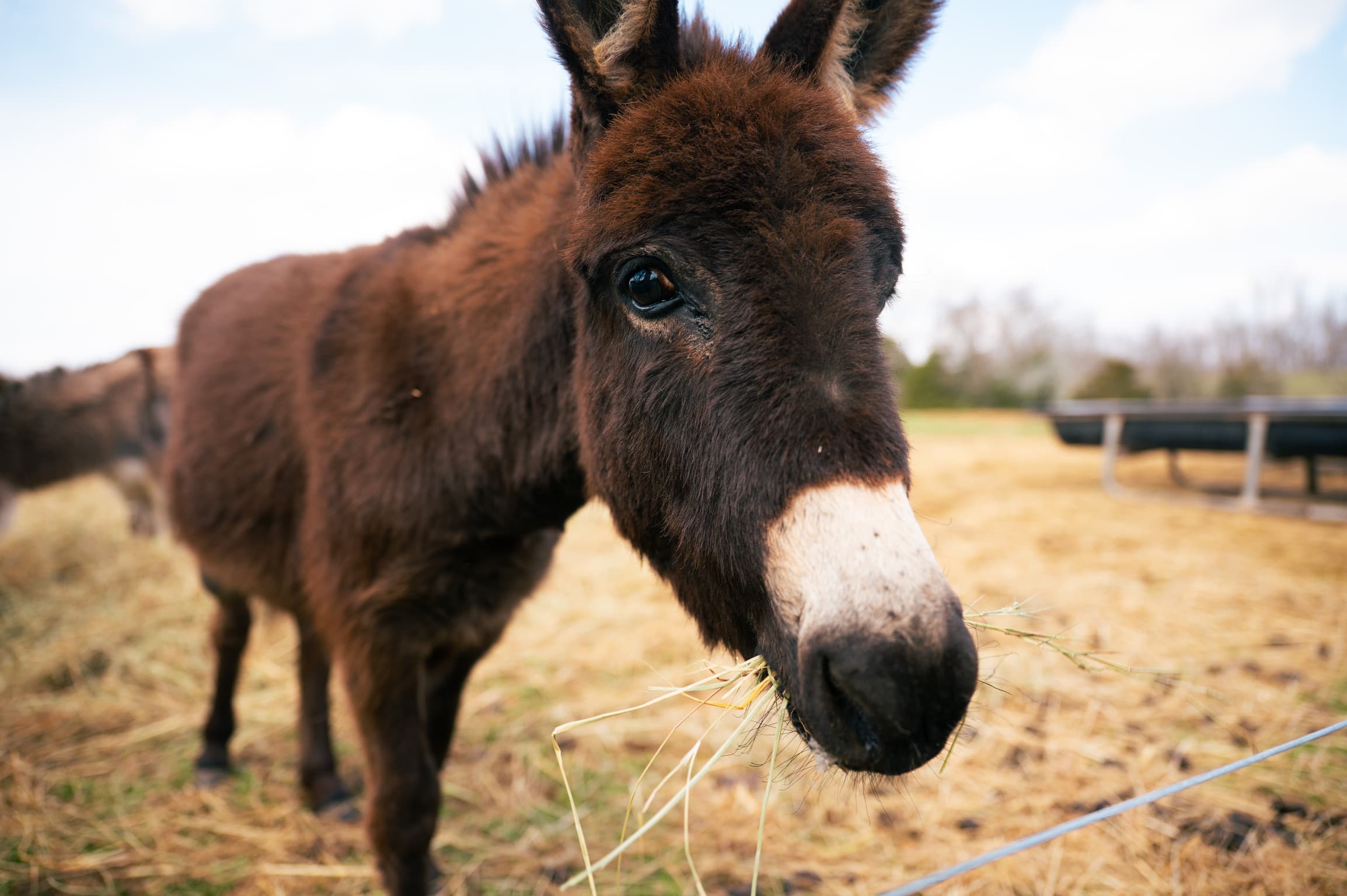
Donkeys are placed in pairs
Donkeys form strong and specific attachments to their companions, and separation causes them genuine distress. An animal that loses its companion may stop eating, develop colic, or decline in condition over a period of weeks.
For that reason we place donkeys in pairs, or into a home that already keeps at least one donkey. Bonded pairs are never separated. Adopters should plan on the cost of feeding and caring for two animals rather than one, and we would encourage you to take that into account before applying.
Requirements
What a donkey requires
The requirements below are set out in full because an unsuitable placement is harder on the animal than remaining in our care, and because each of these is considerably easier to arrange before an animal arrives than afterwards.
Companionship
Donkeys form strong and specific attachments to other donkeys, and they do not do well when kept alone. We place them in pairs unless the adopter already keeps a donkey for the new arrival to join. Horses, goats and other livestock are not an adequate substitute for equine company.
A lifespan of 40 to 50 years
Donkeys commonly live for forty to fifty years, which is considerably longer than most people expect. The application asks where you expect to be living in ten years, and who would take responsibility for the animals if you were no longer able to. We ask you to answer both of those carefully.
Restricted grazing and dry shelter
Donkeys evolved in arid conditions and are prone to laminitis on rich pasture, so they need a dry lot or another reliable way of limiting grazing. Their coats are not waterproof, and they require shelter that is enclosed on at least three sides, dry underfoot, and large enough for both animals to use at the same time.
Secure fencing
Donkeys test fencing persistently, and they will lean on, chew, or push through anything insubstantial. Barbed wire is not acceptable under any circumstances, because the injuries it causes are severe. This is the one requirement on which we are unable to be flexible.
Routine hoof and dental care
Hooves need attention every six to eight weeks, whether or not the animal is ridden, and neglected feet cause lasting damage. Donkeys also require annual dental examinations, vaccinations, and a worming program based on fecal egg counts rather than a fixed schedule.
An established veterinary relationship
Please identify a large animal veterinarian who will attend your property before you apply rather than afterwards. Some small animal practices do not treat equines, and some large animal practices are not accepting new clients. The application asks for the practice details and whether you have already spoken with them.
Costs
The adoption fee, transport, and ongoing care
$1,000
Adoption fee, non-refundable
The adoption fee is $1,000 per adoption and it is not refundable. It is applied directly to feed, hay, farrier services, and veterinary care for the animals still in our care. No payment is taken when you apply, because the fee is arranged only after we have spoken and agreed that a particular animal is a suitable match.
$2.50 per mile
Only if you would like us to deliver
Transport is the responsibility of the adopter. You are welcome to collect the animals yourself or to engage a commercial transporter. If you would prefer that we deliver them, we charge $2.50 per mile measured one way from our property in Leoma, Tennessee, and we do not charge for the return journey. Transport is arranged and paid for separately from the adoption fee.
Ongoing costs
For the lifetime of the animals
Routine costs include hay, feed, farrier visits, vaccinations, worming, and dental care, and adopters should also allow for treatment that has not been planned for. Colic surgery, as one example, can run to several thousand dollars. The application asks how you would meet an unexpected veterinary bill of $2,500.
The process
From application to placement
Submitting an application does not guarantee a placement. We match animals to homes according to what each particular animal needs, which occasionally means declining a well-qualified applicant for one donkey and approving them for another.
You submit an application
The application has eleven sections and asks detailed questions about your property, your experience, and your plans for the animals. It saves as you go and provides a private link, so that you can gather the information you need and complete it across more than one sitting.
We discuss it with you
We will contact you to talk through your application, the requirements set out above, and which of our donkeys might be suitable for your circumstances. This is also the point at which we would encourage you to ask us anything you need to know.
We contact your references
We speak with your veterinarian and with two personal references who are not members of your family. We are confirming that the arrangements you have described are genuinely in place.
We assess the property
We visit the property where the animals will be kept, or we arrange a video walkthrough if the distance makes a visit impractical. We are assessing shelter, ground conditions, and fencing, and nothing else.
You meet the animals
We invite you to spend time with the donkeys we have identified as a possible match. Donkeys respond differently to different people, and it is worth establishing that before a placement is agreed.
Placement, and our continuing responsibility
If the placement proceeds, we remain available to you afterwards. Should the arrangement cease to work at any point, and for any reason, the donkeys return to us. Adopters agree not to sell, trade, give away, rehome, or send the animals to auction, and that condition does not expire.
Preparing to apply
Information you will need
- You will need the name and telephone number of a large animal veterinarian, and ideally you will have spoken with them already.
- You will need the name and telephone number of your farrier, if you have engaged one at this stage.
- You will need two personal references who are not family members, with telephone numbers for both.
- You will need the name of the person who would take responsibility for the animals if you were unable to.
- You will need an approximate monthly budget for their care.
- You will need your total acreage, the fenced acreage available to the animals, and the type and height of your fencing.
The application saves your answers as you go and provides a private link back to it, so you are able to stop partway through, obtain any information you are missing, and resume on the same device or another one.
Start an applicationIf you would prefer to speak with someone before you begin, please write to [email protected].
If you are looking to place an animal with us instead
We accept horses and donkeys into our program, and animals accepted into it are surrendered to us in full. We are not a boarding or retirement facility, and we are unable to offer arrangements in which the owner retains control. Please read our intake and ownership policy.